


During the peak of wildfires in Brazil, the concentration of fine particulate matter in the atmosphere reaches levels that compromise indoor air quality even in cities far from the fire hotspots. In 2024, the World Health Organization had already noted that more than 99% of the world’s population breathes air that exceeds recommended pollution limits, with 7 million premature deaths per year associated with this factor. During seasons such as the second half of the year, when the Midwest experiences low humidity and a high incidence of wildfires, monitoring indoor air quality ceases to be a matter of comfort and becomes a technical operation.
Why the air inside buildings also gets worse
When outdoor smoke levels rise, the air entering through natural infiltration and the outdoor air intakes of HVAC systems carries with it the same particulate matter that is suspended outdoors. Particles with a diameter of less than 2.5 micrometers, classified as PM 2.5, pass through the respiratory tract, reach the pulmonary alveoli, and enter the bloodstream.
In buildings with poorly designed HVAC systems or systems that are overdue for maintenance, the situation worsens. Clogged filters lose efficiency, poorly sealed ducts allow untreated air to enter, and outdoor air intakes located near sources of pollution draw in exactly what you want to avoid.
The Role of Filtration in Air Conditioning Systems
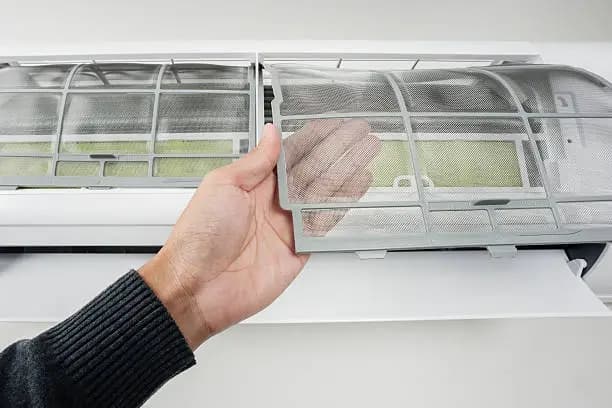
Filtration is the first line of defense against particulate matter. In medium-sized commercial and residential systems, the use of standalone G4-class filters is often insufficient to capture fine particles. The combination of pre-filters with F7, F9, or HEPA filters—specified according to the application—increases particle retention to levels suitable for environments that require controlled indoor air quality. Hospitals, laboratories, cleanrooms, and high-occupancy corporate environments are examples where this filtration chain is no longer optional.
Patrick Galletti, a mechatronics engineer and CEO of Grupo RETEC, often emphasizes that filtration must be treated as part of the system, not as an accessory. The choice of filter is directly linked to the equipment’s static pressure, the air velocity in the duct, and the maintenance plan. A high-efficiency filter installed in a system that was not designed to support it causes a drop in airflow, motor overload, and a loss of performance.
Air Renewal and Balance Through Filtration
During wildfire seasons, air exchange becomes an engineering decision, not an automatic routine. Drawing in untreated outdoor air during peak smoke levels simply brings the problem indoors. The technical solution lies in air treatment systems that combine controlled air exchange with fine filtration, maintaining indoor carbon dioxide levels within safe ranges without compromising air quality.
In medium- and large-scale projects, the correct specification of air handling units, motorized dampers, air quality sensors, and appropriate filters determines the system’s actual performance during critical atmospheric events. The design must take into account not only operation on normal days, but also the system’s ability to keep the indoor environment protected when outdoor air quality deteriorates.
Some groups are more vulnerable to the effects of pollution caused by wildfires, such as:
When the purifier works and when it doesn't
Standalone air purifiers are clearly suited for residential environments and small commercial spaces. Models with HEPA filtration reduce the concentration of fine particles in the treated air volume, helping to alleviate respiratory symptoms in more sensitive individuals. Limitations arise when the equipment is installed in environments where the airflow volume far exceeds its treatment capacity, in locations with uncontrolled air infiltration, or when it is used as a substitute for maintenance of the central HVAC system.
In commercial, corporate, and hospital buildings, the correct approach is technical and centralized. Air purifiers can supplement critical areas, but the foundation of control lies in the HVAC system, the specified filtration, the properly sized air change rate, and periodic maintenance in accordance with the PMOC, as required by law.
What to Consider Before the Next Season
A few practical measures can reduce the impact of wildfires on indoor environments:
- - Assess the condition of the installed filters and the specified class for each piece of equipment.
- - Check the sealing of the ducts and the positioning of the outside air intakes.
- - Verify compliance with the Maintenance, Operation, and Control Plan (PMOC) and the frequency of cleanings.
- - In corporate and hospital settings, review the capacity of the air handling system to support fine filtration without a loss of airflow.
- - Consider air quality sensors to monitor PM 2.5 and CO₂ concentrations in real time.
RETEC provides solutions for air conditioning, ventilation, and air treatment systems in medium- and large-scale projects, including filtration, air exchange, and thermal insulation. For technical decisions tailored to each application, please contact our team.
We were featured in an article on this topic on Terra (Life & Style / Health). The role of air purifiers during wildfire seasons was discussed in an interview with Patrick Galletti, CEO of Grupo RETEC. Read it at: https://www.terra.com.br/vida-e-estilo/saude/com-queimadas-purificadores-de-ar-previnem-doencas-respiratorias,abf9f4587c3c58a3d846e475d538d1364tfnxhgf.html